> For the complete documentation index, see [llms.txt](https://docs.powerviz.ai/powerviz/llms.txt). Markdown versions of documentation pages are available by appending `.md` to page URLs; this page is available as [Markdown](https://docs.powerviz.ai/powerviz/horizon-chart/introduction.md).
# Introduction
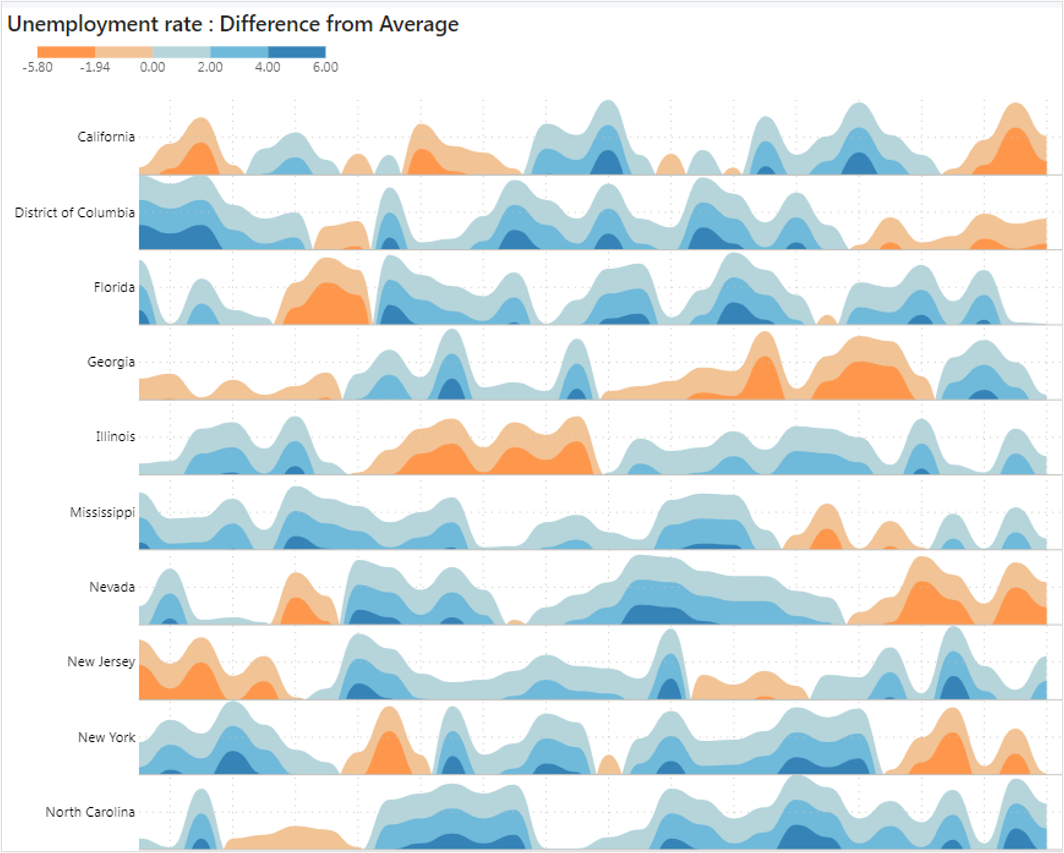
The Powerviz [Horizon chart](https://powerviz.ai/) is a two-dimensional data visualization that shows quantitative data across a continuous interval, usually a period. It is a compact area chart that compares data across multiple categories. The layered view allows more categories to be seen within the same space, improving comparison and pattern detection.
It is available for download on [AppSource](https://appsource.microsoft.com/en-us/product/power-bi-visuals/truvizinc1674781244292.horizon-chart-by-powerviz?exp=ubp8\&tab=Overview) & directly from the [website](https://powerviz.ai/pricing). Powerviz visual allows you to control several layers, baseline, conditional formatting, annotation, and more.
This documentation will help you get started with the Horizon chart by explaining everything you need to know about it. If you're new to our site, check out the [visual library](https://powerviz.ai/visuals) for other visuals that met your requirements.
**Powerviz Horizon chart highlights include:**
* `Horizon Options` - Customize the Horizon `area`, `scale`, & `base values`.
* Create `custom themes` & save and share them in `JSON file`.
* `Display Style` - Choose from a variety of curvature styles - `natural`, `linear`, and `step` - to effortlessly create impactful designs.
* Apply color with `by layer` the option to create custom bands.
* Customize with a wide range of options, including `6 color schemes` and over `30+ stunning palettes` to choose from. In addition, apply `conditional formatting` rules.
* Control the `scaling` and number of `layers` of the Horizon area with precision.
* Add `Reference lines` to highlight a range or a data point.
* Choose from a wide range of pre-designed `fill patterns` or upload your design.
* `Ranking`, `sorting`, `gridlines`, & other such features are available too.
Follow this **guide** to have an in-depth view of the Powerviz Horizon chart. To know more about other Powerviz visuals and slicers, visit our [`library`](https://powerviz.ai/visuals) or [`contact us`](https://powerviz.ai/contactus) directly for a demo.
### Examples[](https://docs.powerviz.ai/horizon-chart-introduction#examples)